
Documentary vs. Traditional Wedding Photography in Portugal
Somewhere along the way, wedding photography became a choice between two supposedly opposite things. I’m not convinced.
PORTO, PORTUGAL / EVERYWHERE ELSE · SCROLL TO DISAGREE ↓

Documentary meets cinematic. Wedding photography at Palácio Correia Mor, Lisbon.
TWO SIDES. ONE BAD QUESTION.
If you're choosing a wedding photographer in Portugal, you've probably seen the same promises everywhere: natural moments, no posing, nothing staged. Nice words. Not the whole story.
Documentary or traditional. Natural or posed. Real or staged.
It's a convenient way to sell photography. I'm not convinced it's a particularly good way to understand it.
A photograph can be directed without looking traditional. It can be carefully composed without being staged. It can look cinematic because someone noticed the light, moved two steps to the left and asked you to stay exactly where you were.
And a photograph can be completely spontaneous and still be terribly boring.
Sometimes the difference isn't technique. It's taste.
POSED IS A METHOD. TRADITIONAL IS AN AESTHETIC.
THE POSE ISN'T THE PROBLEM.
When people say they don't want traditional wedding photography, I suspect they're often talking about a particular kind of image.
The familiar compositions. The predictable gestures. The photographs that seem to belong to every wedding and nobody's wedding in particular.
I understand that.
But posing isn't the problem.
Directing someone is simply one of the tools available to a photographer. What matters is what you do with it, and why.
You can spend twenty minutes arranging a photograph that looks like it came from a wedding catalogue. Or you can give someone one small instruction and make a portrait that feels strange, intimate, funny, beautiful or slightly uncomfortable.
Both involve direction.
They don't belong to the same visual world.


A COMPLETELY SPONTANEOUS PHOTOGRAPH CAN STILL BE TERRIBLY BORING.
THERE. I SAID IT.
I'M NOT A SURVEILLANCE CAMERA.
I photograph a lot of things as they happen. People talking, drinking, waiting, smoking, getting distracted. The moments before something important, and the ones nobody thought were important at all.
I like being inside what's happening rather than watching it from a safe distance.
But I'm not a surveillance camera.
Sometimes I'll move you into better light. Sometimes I'll ask you to stop moving for a second. Sometimes I'll make a suggestion because I've noticed something interesting between two people.
And sometimes I'll leave everything alone.
The distinction matters.
Documentary photography is an approach to observing people. It isn't a promise never to interfere.
A little direction doesn't automatically make a moment less honest.

AWKWARD IN FRONT OF THE CAMERA? GOOD.
Most people aren't used to being photographed.
They don't know where to look, what to do with their hands or whether they're supposed to smile. And telling someone to “just be natural” is probably one of the least helpful things a photographer can say.
So yes, I give directions.
Clear ones, when they're needed.
But I also tease people a little. I talk. I make jokes, sometimes terrible ones. I pay attention to how people respond, what makes them laugh, how they behave with each other.
I'm looking for the points where we connect.
Not because we need to become best friends in fifteen minutes. We don't.
But there needs to be something human between us.
Enough trust to make a suggestion without making you feel ridiculous. Enough understanding to know when to push a little and when to disappear.
The photograph comes from there. Not from a list of poses I brought to your wedding.


The photographer
THE WAY I SEE IT.
Documentary gets me close. Cinema is how I see what happens.
01 What I notice
The person in the corner, not necessarily the room everyone came to see.
02 How I frame
People, architecture, light. And everything that happens between them.
03 When I step in
Sometimes I direct. Sometimes I just watch. I like knowing the difference.

SILENCE. GRIT. JOY.
There’s room for all of it.
A CHECKLIST TELLS ME WHO WAS THERE. NOT WHO THEY ARE.
Of course, some photographs need planning.
Family portraits matter. Certain people need to be photographed together. Sometimes a few minutes of organisation save everyone half an hour of confusion.
I'm perfectly happy to do that.
What I don't want is to spend the day moving through a checklist while everything interesting happens somewhere else.
Because a wedding is full of things that weren't scheduled.
A strange look across a room. Someone laughing at completely the wrong moment. A badly timed cigarette. Your friends behaving exactly as you knew they would.
You can organise the day. You can't organise all the reasons you'll remember it. And those are often the things I'm looking for.
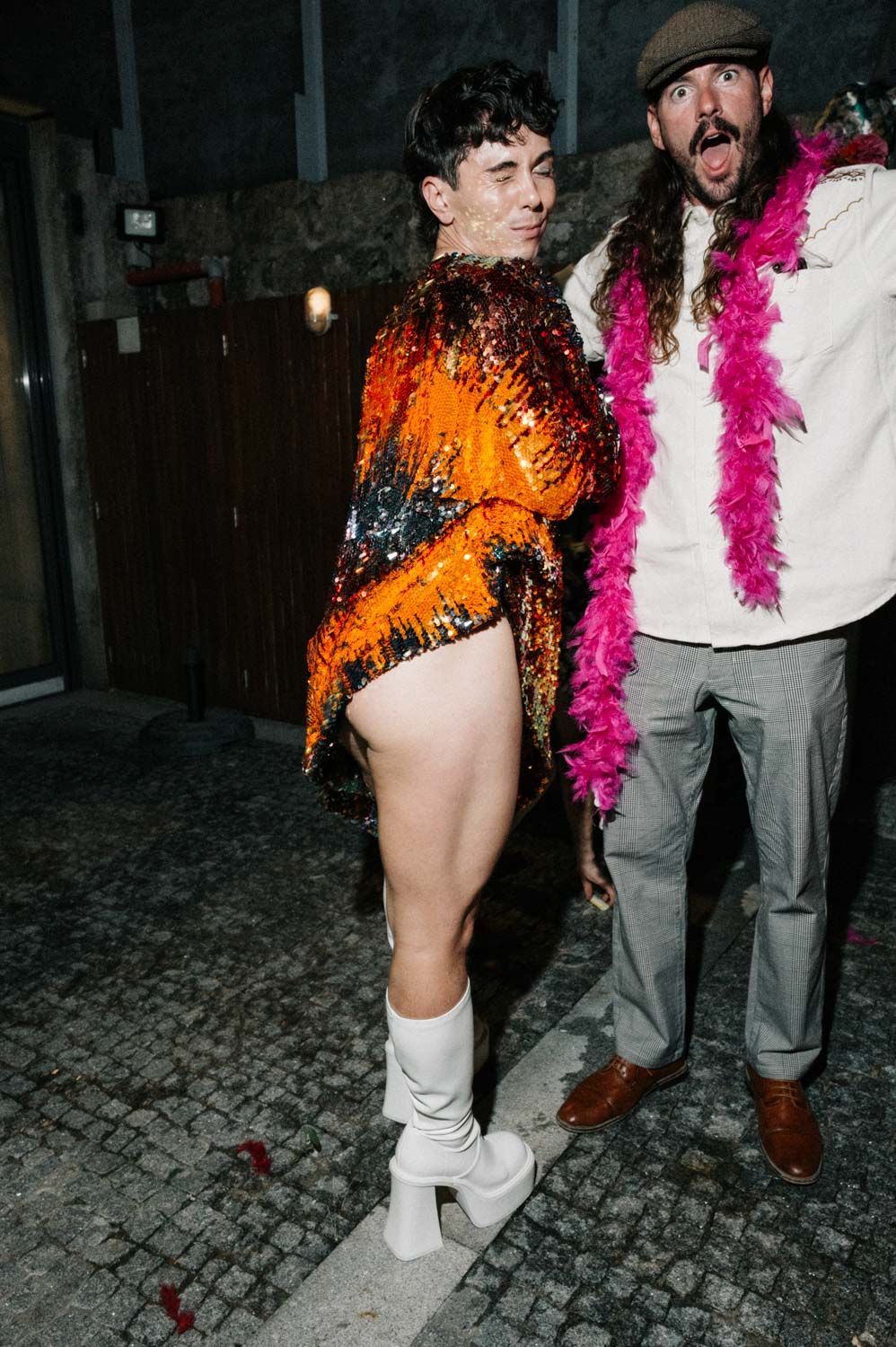

SO WHO SHOULD YOU CHOOSE?
I'd start somewhere other than the labels.
Look at the photographs.
Not just the couple portraits. Look at the people around them. The spaces. The awkward bits. The moments between the obvious moments.
Look at what the photographer notices.
Then ask yourself whether you want that person around you on your wedding day.
If you're planning a wedding or elopement in Portugal and you feel uncomfortable in front of a camera, that's not a reason to avoid having photographs taken.
It's a reason to find someone whose way of working makes sense to you.
Someone who knows when to help, when to provoke and when to leave you alone.
I photograph weddings across Portugal, particularly smaller celebrations, elopements and days where people have room to be themselves.
I won't promise that you'll forget I'm there.
I'd rather we get along well enough that it doesn't matter.
DOCUMENTARY WEDDING PHOTOGRAPHY IN PORTUGAL
Portugal isn't a preset. And your wedding isn't somebody else's.
A quiet morning with Sunny & Kim at The Yeatman in Porto asks for a different kind of attention from Ashley & Khale at Pico do Refúgio in the Azores.
Not because one place looks more cinematic than the other. Because people aren't interchangeable. Neither are the rooms, the light, the small things that happen when no one's thinking about a photograph.
That's what documentary wedding photography in Portugal means to me: paying attention first. Directing when it helps. Keeping my eyes open for everything a checklist doesn't know about.
FAIR QUESTIONS.
Can documentary wedding photographs be directed?
Of course. I might ask you to move into better light or give one small suggestion when you feel awkward. Documentary isn't a ban on direction. The point is to leave room for you to be yourselves.
Do you photograph elopements and small weddings in Portugal?
Yes. I'm based in Porto and photograph small weddings and elopements across Portugal. If that's what you're planning, here's how I approach elopements.
Will you tell us how to pose?
If you need help, yes. Small, clear directions. No choreography marathon. And no requirement to know what to do with your hands.
Do you still photograph our families?
Of course. We can make a short family list and photograph the important groups without turning the whole day into an organised photoshoot.
Is your work documentary or cinematic?
Both ideas influence how I see. But labels only get you so far. Look at the photographs, the composition, the people and how each image feels. That's the better explanation.
Where do you photograph weddings?
I'm based in Porto and photograph weddings, intimate celebrations and elopements across Portugal, including Lisbon, Sintra, the Douro Valley, Algarve and Azores. I also travel internationally.
THE CAMERA IS THE LEAST INTERESTING THING I BRING.
Don't choose a wedding photographer in Portugal because of a label. Look at what they notice. Then ask yourself whether you want that person around on your wedding day. If the answer is yes, we should talk.
